

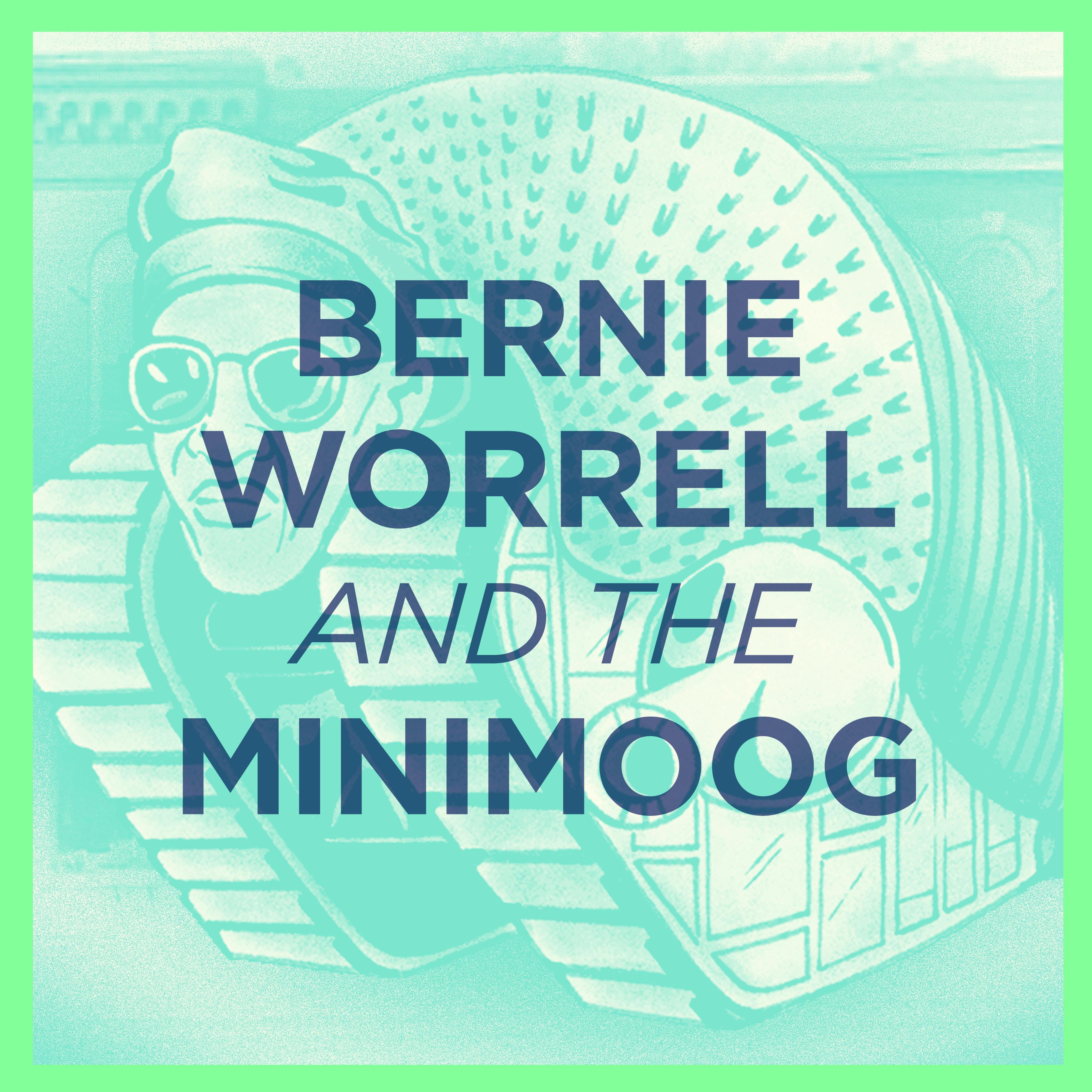


Bernie Worrell & The Minimoog Model D

The huge skull propped up on the stage yells out to the audience “Fire it up!” until an enormous Bic lighter sends up a three foot-high flame to spark up a skeleton’s spliff.
As smoke pours from its nostrils and its eyes begin to glow red orange, the funk begins to flow. George Clinton, usually decked out in hardcore sequined and glittery attire, arrives on stage in a long, shock white wig.
It is the mid-seventies and Parliament Funkadelic had come to redefine just how far out R&B could get. And there, behind the dozen or more band members tearing the roof off whatever coliseum they would visit, was their unobtrusive keyboard player Bernie Worrell turbo driving their futuristic strain of 20th century Soul.

From the first time Worrell heard a synthesized sound, he was immediately drawn to it.
“I deal with sound. I was raised on the classical baby grand, so when I heard something that different, I was immediately attracted to it. It’s like when you’re hearing different birdcalls, or the sounds of a dolphin. A lot of my creative process comes from me getting attracted to a sound and then I create from that.”
The sound that called to Worrell during his freshman year in college was that of Emerson. Lake and Palmer’s “Tarkus” – the second album from the British trio that featured a near 21-minute single track on side one. Keith Emerson had become one of Moog’s chief synthesizer exponents, and the impact his work had on the young musician was fairly profound.
“Keith influenced me a lot and then of course Rick Wakeman came later with Yes.”
"I deal with sound. I was raised on the classical baby grand, so when I heard something that different, I was immediately attracted to it. It’s like when you’re hearing different birdcalls, or the sounds of a dolphin."
It was logical that the complexities of Prog rock would appeal to Worrell, a child prodigy that had studied at Julliard and the New England Conservatory of Music. Less logical perhaps was that he wound up following George Clinton’s doo wop group The Parliments to Detroit to start forming the building blocks of the P-Funk sound. But before he would manage to find his way to electronic instruments, Worrell began to cultivate a stylistic approach with an RMI Electra Piano that would approximate his future mastery of the Minimoog Model D.
“It had just come out. There were two of them at this music store called Wonderland in Detroit. Stevie Wonder got the first one and I just happened to get the second one. I used a wah-wah pedal with it and people used to say that it sounded like a synth, but it wasn’t. So I guess it was already in my head....the approach.” Worrell had seen pictures of Emerson’s modular, but he didn’t come across a Model D until he had Clinton buy him one.
“George may have purchased it for Bernie, but Bernie and I were always looking for sound enhancement gear.” P-Funk bass player Bootsy Collins remembers. “(I was) very impressed with the Minimoog. In fact I already had the under water sound going on with my Mutrons, but then I had to catch up with Bernie so I got me a Electro Harmonix Bass Micro Synth pedal that allowed me to imitate some of Bernie's sounds."
The sound that called to Worrell during his freshman year in college was that of Emerson. Lake and Palmer’s “Tarkus” – the second album from the British trio that featured a near 21-minute single track on side one. “Keith influenced me a lot and then of course Rick Wakeman came later with Yes.”
The historical waters of P-Funk are often murky but it seems that a Minimoog must have entered into the equation by sometime in 1976, since you can hear its distinctive LFO gurgles by the time the band arrives at the opening track of “Tales of Kidd Funkadelic.” It was a period of several shifting elements. Clinton was moving his multi-headed organization to a major label (Warner Bros. Records) and dance floors were seeing a titanic shift to Disco. Standing apart from what Clinton saw as a blatant commercialization of the rootsy organic sounds that had driven his career, the various members of the Parliament Funkadelic camp didn’t have a truly mainstream flag to plant on the Pop spectrum – yet.
“I think that 'Flash Light' was the first serious, conscious effort to cut a hit single.” George Clinton told Blues & Soul magazine. Borne upon three tracks of wide ranging Minimoog sounds, “Flash Light” was originally worked up by Bootsy Collins for a solo record that legendary bassist was in the midst of putting together. But Bootsy wasn’t having it.
“The reason I rejected it was because after my brother (Phelps "Catfish" Collins) and I put the rhythm track down, George was so adamant about having the track for Parliament because I had just recorded "Bootzilla” for my album. At the time Bootzilla fitted my character I was trying to develop so it made more sense to give George the track for Parliament. We always agreed that we wanted each group to have at lease one hit on all the albums that George was producing.” Worrell took up the song’s cause at United Sound Systems studios in Detroit. “There was only drums and guitars when I heard it. I listened to what was there and I came up with that Moog bassline. I just said ‘Roll the tape!’ and I played what God sends through me. “
At the console was veteran Detroit engineer Jim Engineer Jim Vitti who was adjusting to the new approaches that Bootsy and Bernie were laying down. “He did not understand what we were doing at first. And why? Because we didn’t either” Collins maintains. “But it was an addiction that Bernie & I felt about pushing these instrument to another level. Not just playing them good, but getting other un- worldly sounds out of them and talking back and forth to the instrument and in return the instrument would talk to the people. Once Jim Vitti saw what Bernie and I were doing, he jumped in and started to help us by fitting our sounds together in the track by using certain frequencies so that we both can be heard without fighting the sound of one another.”
It was a period of several shifting elements. Clinton was moving his multi-headed organization to a major label (Warner Bros. Records) and dance floors were seeing a titanic shift to Disco.
Released on the “Funkentelechy Vs. the Placebo Syndrome” in January 1978, “Flash Light” became the band’s first #1 single on the R&B charts, while reaching the #16 position on the Pop charts. A huge commercial success, the attention the record drew to the band and to Worrell’s work is hard to overstate.
“None of us knew it was going to be as huge as it was,” Worrell insists. “We were just working.” “Once Bernie put his keyboard work on it, the track was an unusual but definite hit.” says Bootsy Collins. “It set up all the Minimoog bass lines to come from other groups after ‘Flashlight’ was done.”
Funkadelic’s music would come to be continually sampled by successive generations of Rap and Hip Hop artists, and their mid-70’s work in many ways became the template that Prince would use to map out a significant portion of his output.
“A key moment for me in learning synth bass playing was ‘Flash Light.’” says Patrick Gemayel AKA P-Thugg of the band Chromeo. “The whole track is centered around the Model D bass sound. I would just put on ‘Flashlight’ for hours, create the sound and play everything musically and synth-wise. That’s how genius Bernie Worrell was.”
The Model D that Worrell used during Parliament’s heyday would unfortunately be stolen from a car parked out front of a studio where he was doing a session date. But he would continue to play them throughout his career; his affection for the instrument and the Minimoog Voyager that followed was truly sensual and unwavering.
“Bernie doesn't get enough credit for what he did with the Minimoog,” Collins say of his longtime partner. “(It) became a part of Bernie. The sounds he heard in his head he could dial in very quickly with no help. He brought the sound of the Minimoog to all the Funky people that were not just in the Hood, but under the Hood. We were all developing the future and now here we are in it. Those sounds still sound good to people that is why the sound of the Minimoog is so sought after now.”

